

Self Build Toolkit
Building your own home is the biggest project most people ever take on — and the one where a good spreadsheet earns its keep. This toolkit covers the whole journey: appraising a plot before you buy, setting and controlling your budget, timing your drawdown mortgage against actual spend, comparing contractors on a fair like-for-like basis, keeping your programme on track, and snagging the finished build. It's built around the DIY Housebuilders' VAT reclaim too, so you capture what you're owed as you go instead of reconstructing it from a shoebox at the end.
Every tool works in Excel and Google Sheets, with formulas locked and inputs in clear yellow cells — type where it's yellow and the maths takes care of itself.
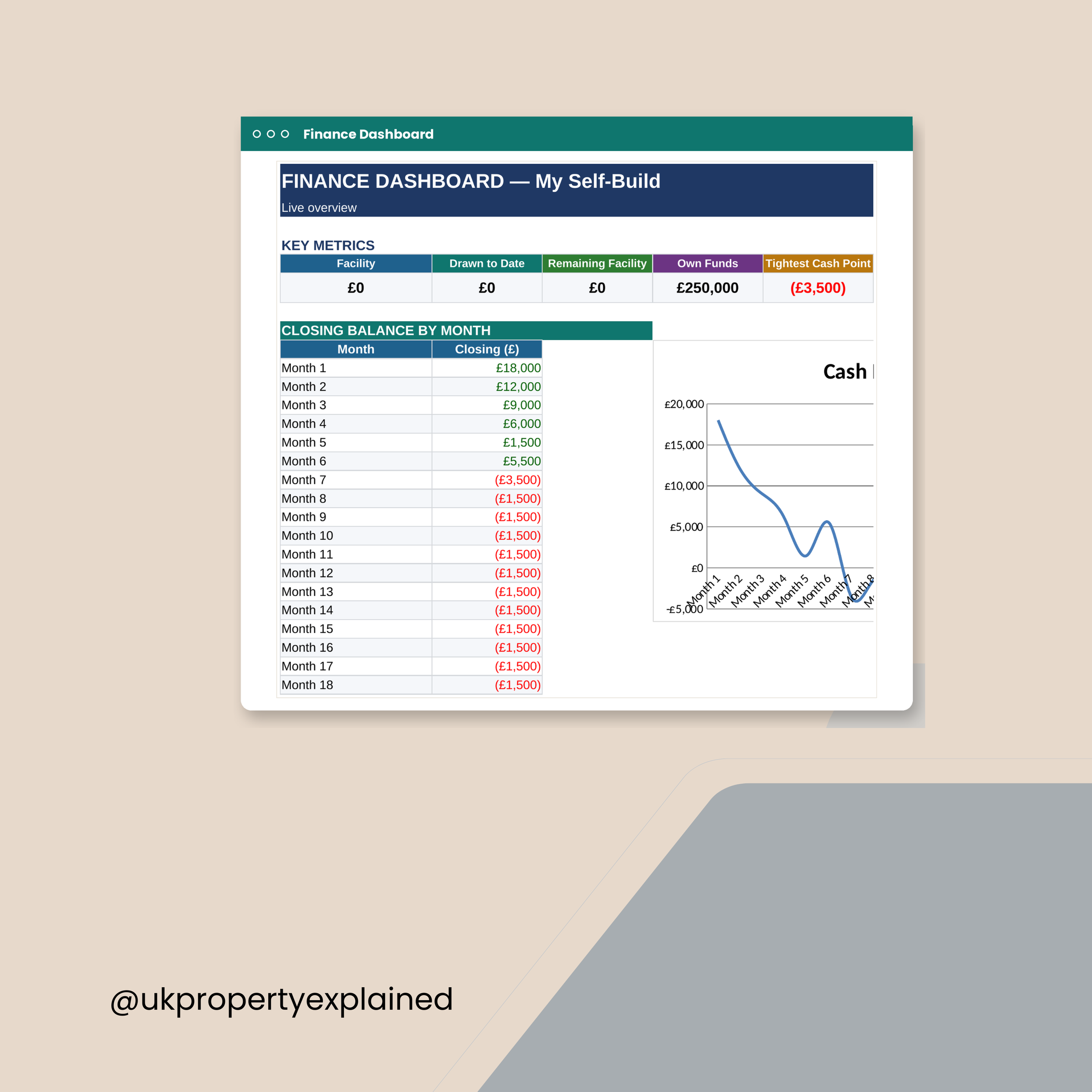
Self-build mortgages release money in stages. Builders want paying now. The
gap between those two facts is where projects stall.
YOUR FINANCE
• Mortgage facility and your own funds
• Stage payment type — arrears (paid after the stage) or advance
THE DRAWDOWN SCHEDULE
All eight build stages. For each: planned drawdown and date, actual received
and date, cumulative drawn, and remaining facility. So you always know what's
left in the facility.
THE 18-MONTH CASHFLOW
Month by month: opening balance, drawdown in, own funds in, payments out,
closing balance — and a Gap? flag when you're about to run dry.
THE DASHBOARD
Facility, drawn to date, remaining facility, own funds, and your TIGHTEST
CASH POINT — the month where it gets closest to the bone.
If you're on arrears drawdown, you fund each stage yourself and get paid back
after. That is the single most misunderstood thing about self-build finance,
and this sheet shows you exactly how much of your own money it demands, and
when.
Excel (.xlsx). Works in Microsoft Excel and Google Sheets. Instant download.
Educational tool only. Not financial or mortgage advice. Correct as of
July 2026.
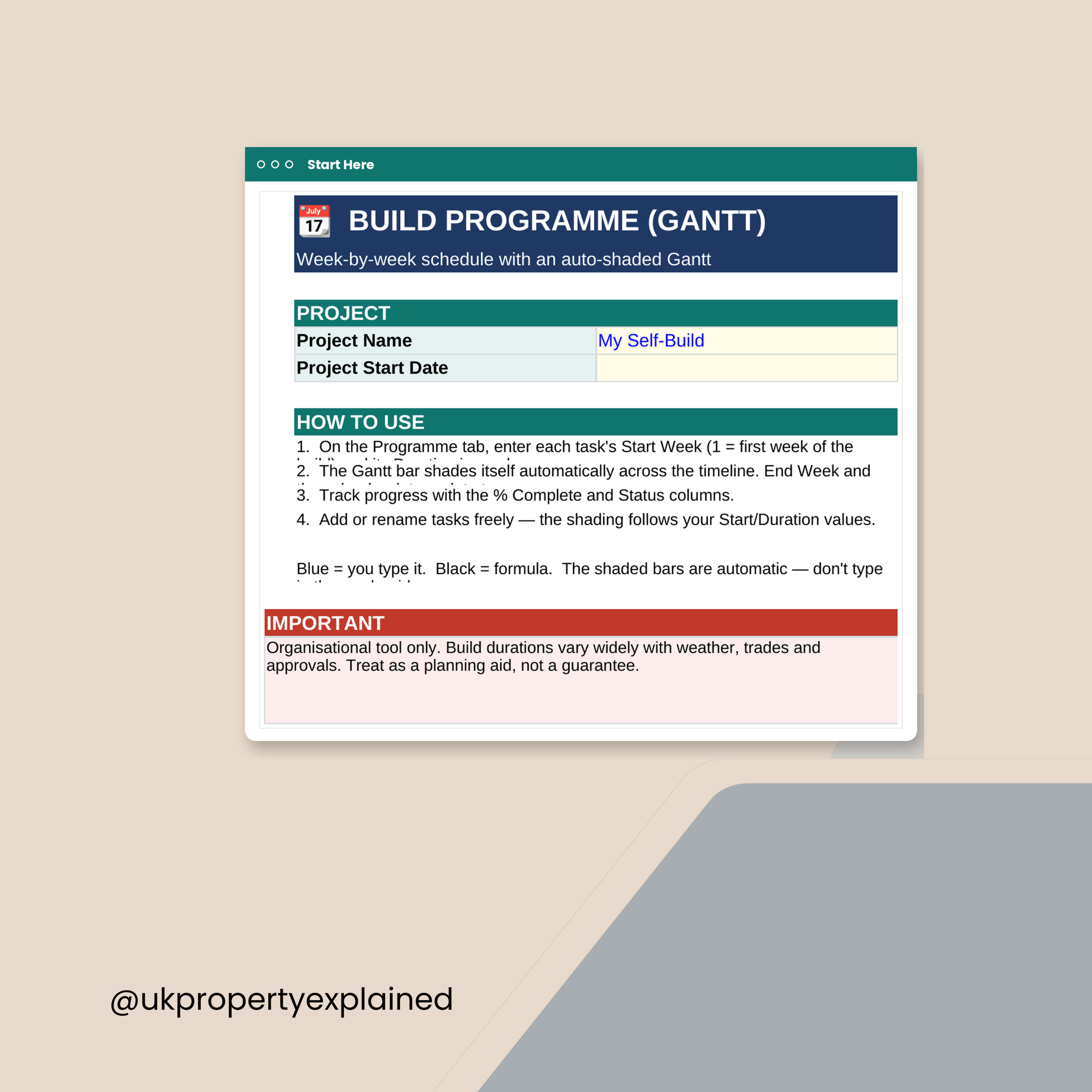
A build programme that draws itself.
Enter a start week and a duration. The Gantt bar shades automatically.
TWENTY TASKS, PRE-LOADED
Site setup and clearance, groundworks, foundations, ground floor slab,
superstructure walls, roof structure, roof covering, windows and doors,
first fix electrics, first fix plumbing, insulation, plasterboard and
plaster, second fix electrics, second fix plumbing, kitchen, bathroom,
flooring, internal joinery, decorating, external works, snagging and
handover.
FOR EACH TASK
• Owner
• Start week and duration — end week works itself out
• % complete
• Real start and end dates, from your project start date
Edit, add, or delete tasks — it's your build.
Seeing the whole programme on one screen is what stops a two-week slip in
groundworks quietly becoming a two-week slip in handover.
Excel (.xlsx). Works in Microsoft Excel and Google Sheets. Instant download.
Educational tool only. Not construction or project-management advice.
Correct as of July 2026.
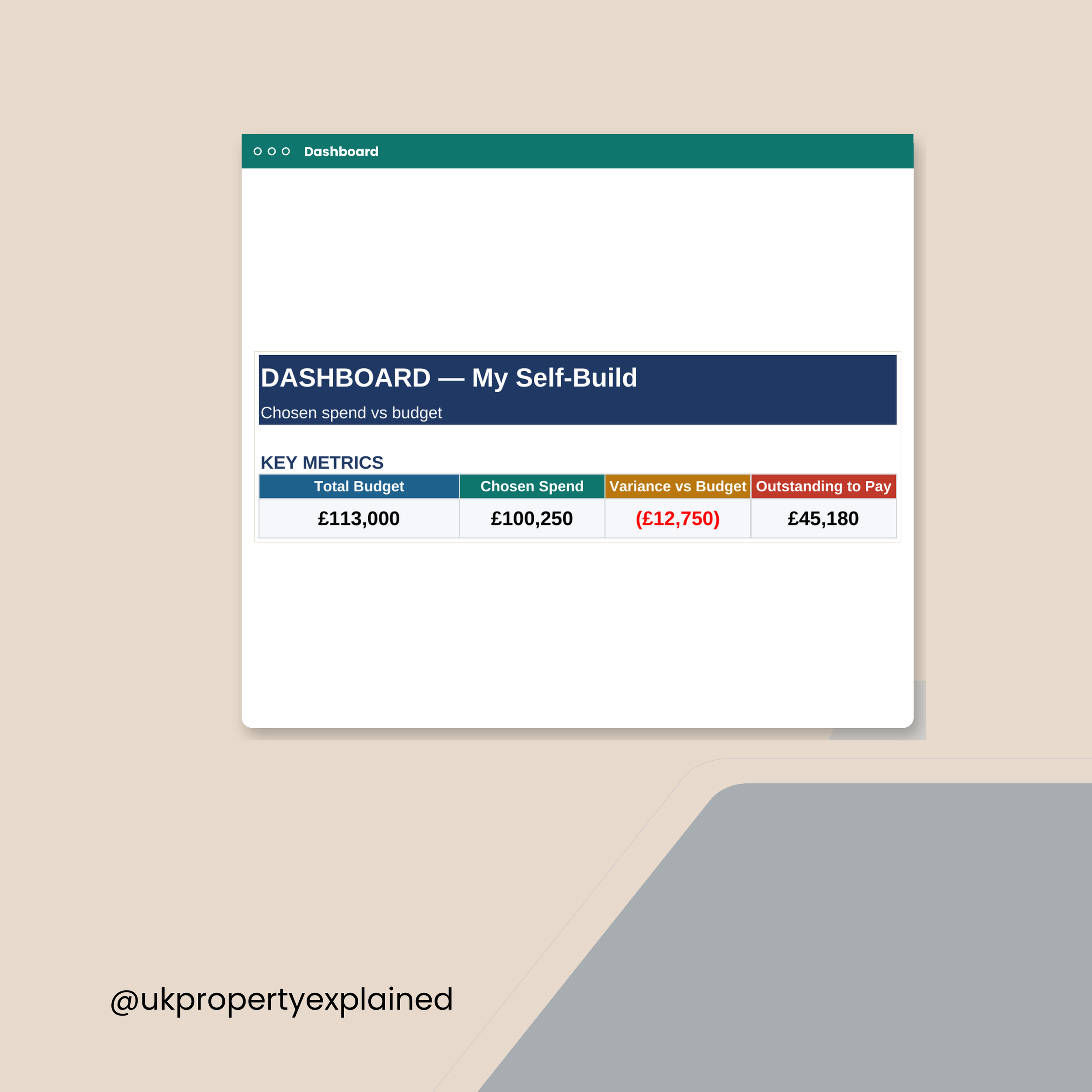
Three quotes, thirteen trades, one honest comparison.
QUOTE COMPARISON
For every work package — groundworks, bricklaying, timber frame, roofing,
windows and doors, electrics, plumbing and heating, plastering, kitchen,
bathroom, flooring, decorating, driveway and landscaping:
• Your budget
• Quotes from up to three contractors
• The lowest quote, worked out for you
• Who you chose, and what you agreed
• Variance against budget
PAYMENT TRACKING
Per contractor: agreed total, deposit, interim, final, total paid, balance
due and status. So you know what's gone out and what's still owed.
THE DASHBOARD
Total budget, chosen spend, variance against budget, and outstanding to pay.
The lowest quote isn't always the one you take — and the sheet doesn't
pretend otherwise. It shows you the gap so you can make the call knowingly.
Excel (.xlsx). Works in Microsoft Excel and Google Sheets. Instant download.
Educational tool only. Not financial or construction advice. Correct as of
July 2026.
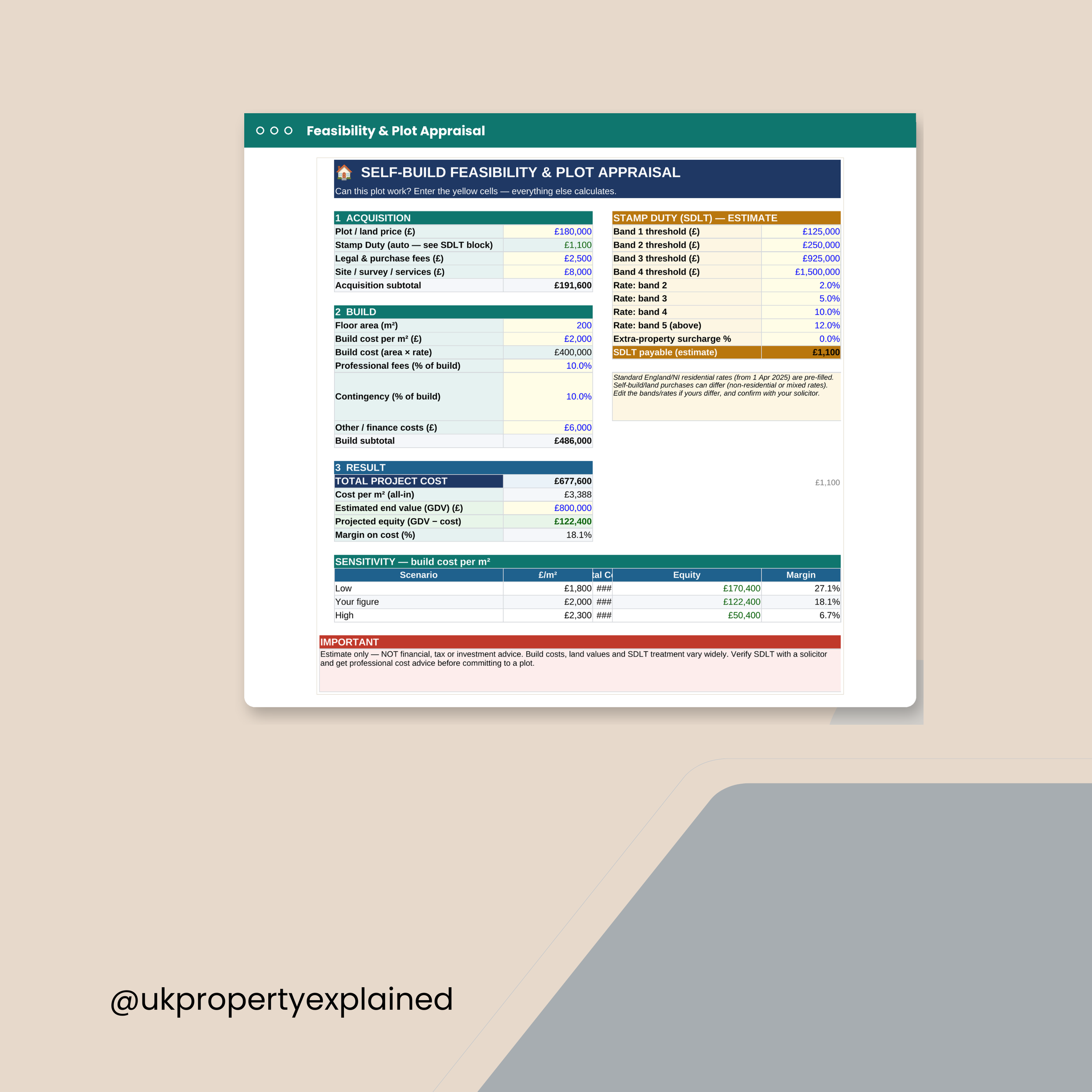
Before you buy the plot, find out whether the build stacks up.
ACQUISITION
• Plot or land price
• Legal and purchase fees
• Site, survey and services
Plus a built-in stamp duty estimate — every band threshold and rate is
editable, including the additional-property surcharge, so you can set it for
your nation and your situation.
THE BUILD
• Floor area in m²
• Build cost per m²
• Professional fees, as a % of build
• Contingency, as a % of build
• Other and finance costs
THE RESULT
• Total project cost
• Cost per m², all in
• Estimated end value (GDV)
• Projected equity — GDV minus cost
• Margin on cost
SENSITIVITY
What happens to your equity and margin if the build cost per m² moves. Because
it will.
Build cost per m² is the assumption that decides whether a plot is a project
or a mistake. This shows you how much room you've actually got before it stops
working.
Excel (.xlsx). Works in Microsoft Excel and Google Sheets. Instant download.
Educational tool only. Not financial, tax or construction advice. Build costs
must be checked locally, and the stamp duty figure is an estimate — confirm
with your conveyancer. Correct as of July 2026.
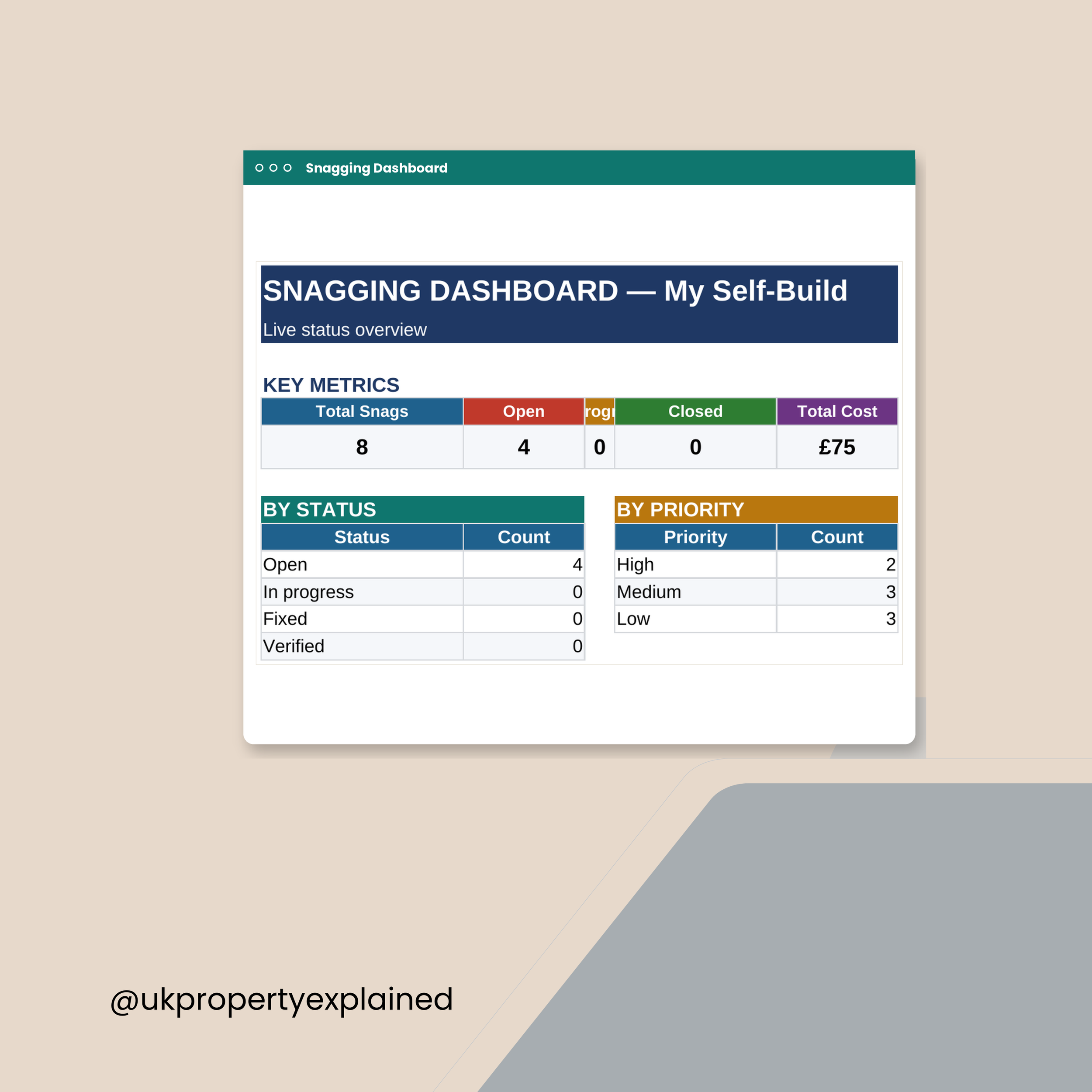
Every defect, logged, assigned and closed out.
ONE ROW PER SNAG
• Reference
• Room or area
• Description of the defect
• Trade responsible — so it lands with the right person
• Priority
• Date raised
• Status
• Date fixed
• Cost
• Notes
THE DASHBOARD
Total snags, open, in progress, closed, and total cost. Broken down by status
and by priority.
Snagging is where goodwill runs out. A written list with a trade against every
item is the difference between "we'll sort it" and it actually getting sorted.
Keep it going after handover, too. Warranty claims are much easier when
there's a dated record.
Excel (.xlsx). Works in Microsoft Excel and Google Sheets. Instant download.
Educational tool only. Not construction or legal advice. Correct as of
July 2026.
Plot to handover. Six tools, one build.
SIX TOOLS
1. Feasibility & Plot Appraisal — does the plot stack up? Land, stamp duty,
build cost per m², fees and contingency against end value, with sensitivity
on the build cost.
2. Budget Tracker & VAT Reclaim Log — eight build stages, budget versus actual,
plus a full DIY Housebuilders VAT reclaim log and eligibility guide.
3. Mortgage Drawdown & Cashflow — stage drawdowns against an 18-month cashflow,
showing the tightest cash point in the whole build.
4. Contractor Quote & Payment Comparison — three quotes across 13 trades, plus
deposits, interims and balances.
5. Build Programme & Gantt Chart — 20 pre-loaded tasks, bars that draw
themselves.
6. Snagging & Defects List — every defect logged by room, trade and priority,
through to closed.
PLUS the How-to-Use Guide (PDF).
Self-builds don't usually fail on the build. They fail on cashflow, on VAT
that never got reclaimed, and on a budget nobody was watching. These are the
tools for those three.
6 x Excel files (.xlsx) + guide (PDF). Works in Microsoft Excel and Google
Sheets. Instant download.
Educational tools only. Not financial, mortgage, tax, legal or construction
advice. Correct as of July 2026.
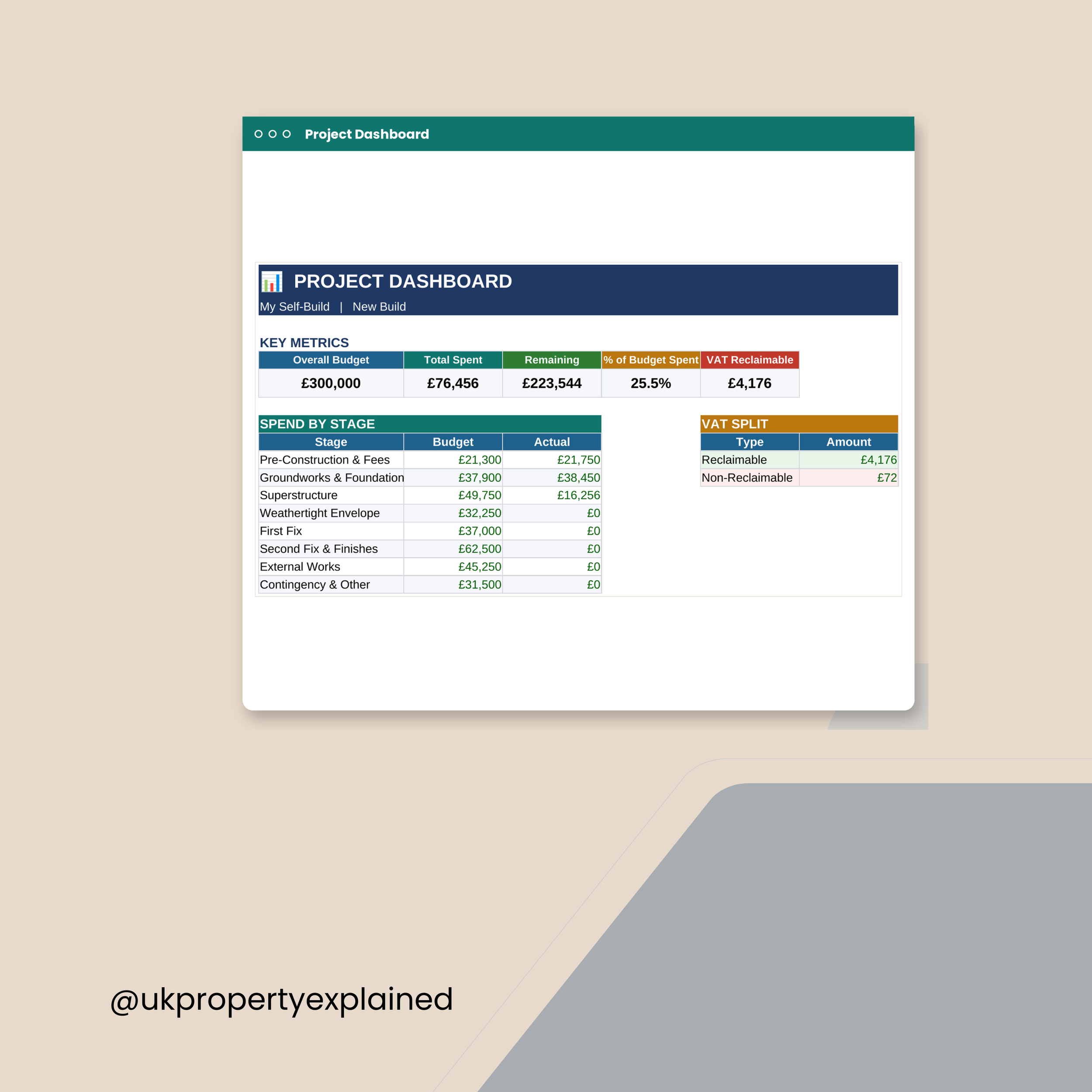
The two things that sink self-builds: losing track of the budget, and losing
the VAT.
THE BUDGET
Eight stages, from pre-construction fees through to external works and
contingency. For every line: budgeted, actual, variance and status. So you
know which stage is drifting while there's still time to do something.
THE VAT RECLAIM LOG
Built for the DIY Housebuilders Scheme. One row per invoice:
• Date, supplier, supplier VAT number, invoice number
• Description and category
• Eligible? — yes or no
• Net, VAT, gross, and reclaimable VAT
THE ELIGIBILITY GUIDE
A plain list of what's typically reclaimable and what isn't. Insulation,
windows, roofing, wiring, boilers, sanitaryware — usually yes. Free-standing
white goods, carpets, most fitted wardrobes, professional fees, tool hire,
furniture — usually no. New-build contractor labour is already zero-rated,
so there's nothing to reclaim.
THE DASHBOARD
Overall budget, total spent, remaining, % of budget spent, VAT reclaimable,
spend by stage, and the reclaimable/non-reclaimable split.
The scheme has a claim deadline. Keeping the log as you go is the difference
between a reclaim and a shrug.
Excel (.xlsx). Works in Microsoft Excel and Google Sheets. Instant download.
Educational tool only. Not tax advice. Check current DIY Housebuilders
Scheme rules with HMRC. Correct as of July 2026.